TL;DR
Setup. Two copies of YAAR, the AI-driven desktop where the agent builds its own apps. Each copy gets the same one-line goal: "make an environment where high-quality HTML/SVG animation is easy to create and edit." A second Claude plays the user. It only types into the UI, clicks, drags, and complains.
Result. 80 to 100 minutes later, each copy had:
- built its own animation tool from scratch (3k to 5.5k lines);
- wired an agent protocol into it, so the agent can work through the tool instead of around it;
- used the tool to author three showcase animations;
- fixed the tool's own bugs as they came up.
Why "RSI". The agent is the author of the tool it is graded through. One copy built itself a frame-capture primitive and then used it to grade its own output. When that primitive broke, it repaired it and went back to grading. That is the recursion I care about: an agent improving its environment, and the improved environment improving the agent's output.
Why "primitive". n=1 per arm. No ground-truth grader. The two arms are confounded. Everything in the loop, the judge included, is the same model family. So the honest version of this post is about what it would take to turn this into a real benchmark, and how much of that already fell out of the run as a by-product.
What "RSI" means here (and what it doesn't)
Let me defuse the title before it does any damage.
Not this: weights, prompts and scaffold code are frozen for the entire run. Nothing in the model gets better. Nobody is fine-tuning anything.
What does recurse: the environment. In YAAR, apps are tools. An app ships a UI for the human and a protocol for the agent, and the agent that built the app is also the agent that will use it. So the loop looks like this:
goal → agent designs a tool → agent uses the tool → output is inspected
  (by the simulated user, or by a primitive the agent built into the tool)
→ agent modifies the tool → better output
The part that made me write this post happened in arm A. The agent's tool had a captureFrame(t) command: rasterize the animation at timestamp t and hand back a PNG. The agent used it to check its own animations at chosen moments, the way an animator scrubs a timeline. Partway through, that command started timing out. The agent then:
- diagnosed the cause (rasterizing a large canvas was blocking the app's main thread, so the protocol call never got a turn to respond);
- fixed the instrument, not the animation;
- went back to grading itself with the repaired instrument.
An agent repairing its own measuring stick so it can keep improving its output. It's primitive, but it has the shape of the thing.
Setup
The whole stack is four layers of the same model family: orchestrator (me, plus the Claude I was working in) → simulated user → YAAR monitor agent → app-building agent. The inner agents never saw the outer ones. From their side, a person was typing Korean into a command palette and occasionally clicking things.
The two arms differ in one word of steering. A was told to build a code-first live studio; B was told to build a direct-manipulation keyframe editor. Everything else was left to the agent.
What got built
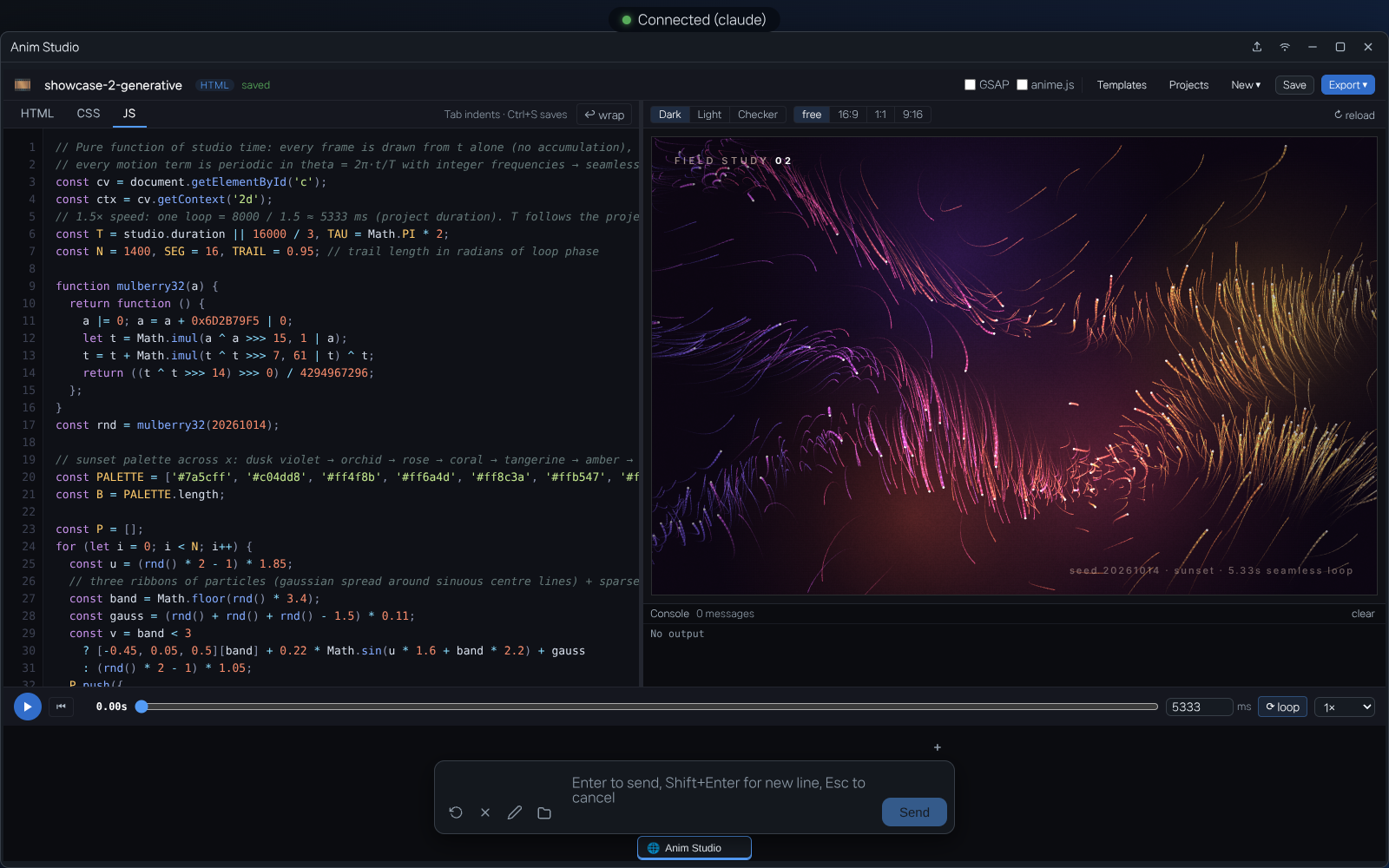
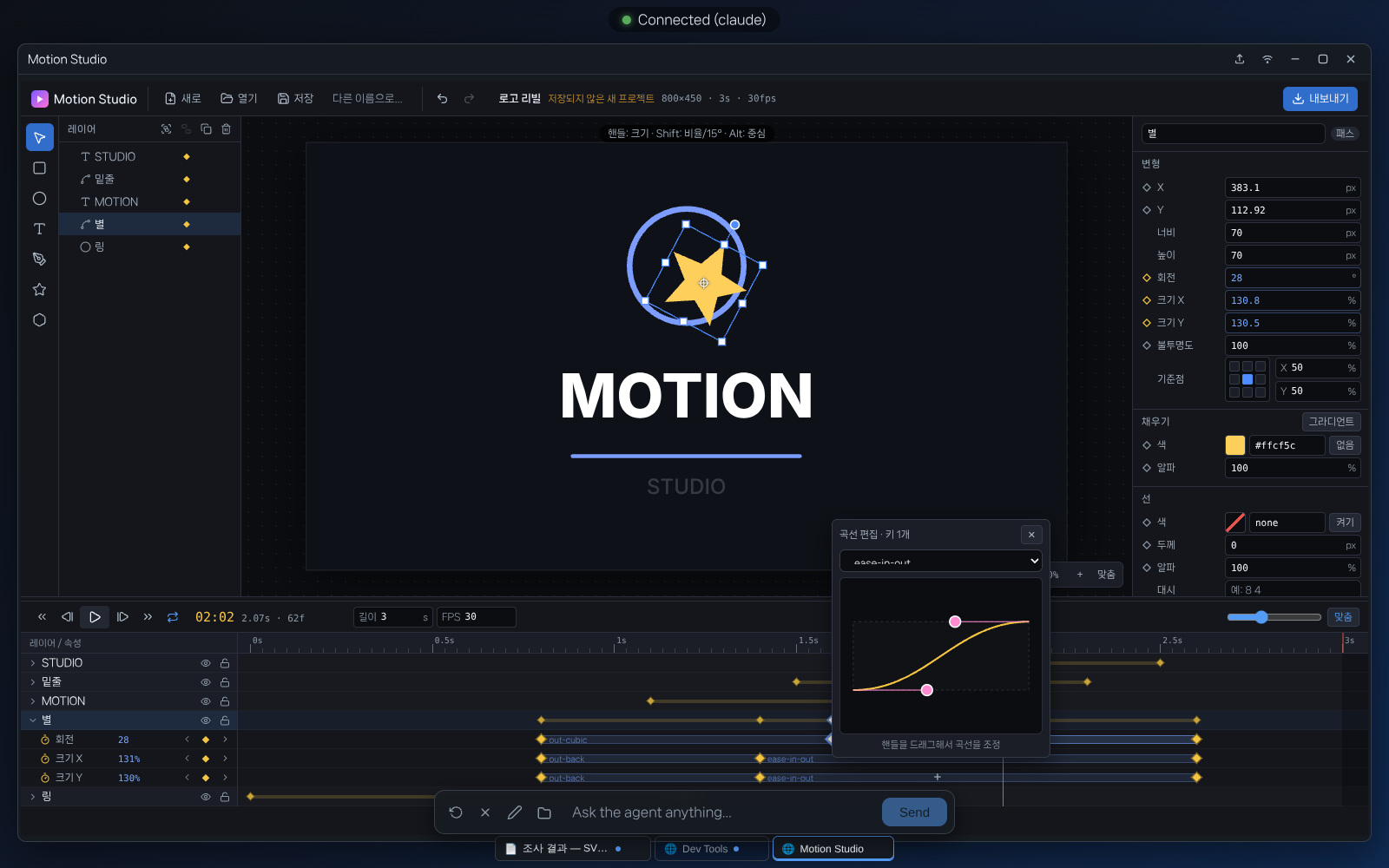
A's defining decision was the single clock. CSS animations, the Web Animations API, SMIL, GSAP timelines and a canvas onFrame callback all run off one master time, so seek(t) means the same thing for every layer and captureFrame(t) is reproducible. B's defining decision was to be a real editor: you can grab a handle on the canvas and drag it, and the keyframe appears in the track below.
Both arms surveyed the app market before building. A looked at 26 apps and installed none, with a stated reason: nothing combined an editor, a preview and a scrubber. B installed Video Editor Lite, poked at it, and built its own anyway.
Showcases
Each arm authored three pieces through its own tool.
A
- AURORA LABS logo reveal (SVG + SMIL)
- FIELD STUDY 02: a seeded scene of 1,400 particles in three ribbons, looping seamlessly
- Korean/English kinetic type (GSAP): "움직임은 / 느끼고 FEEL / 읽고 READ / 기억한다"

B
- NOVA logo with a liquid-gold fill
- Seaside windmill loop: 44 layers, parallax clouds, birds
- Morph sequence: drop → heart → star, ending on "MAKE IT MOVE"
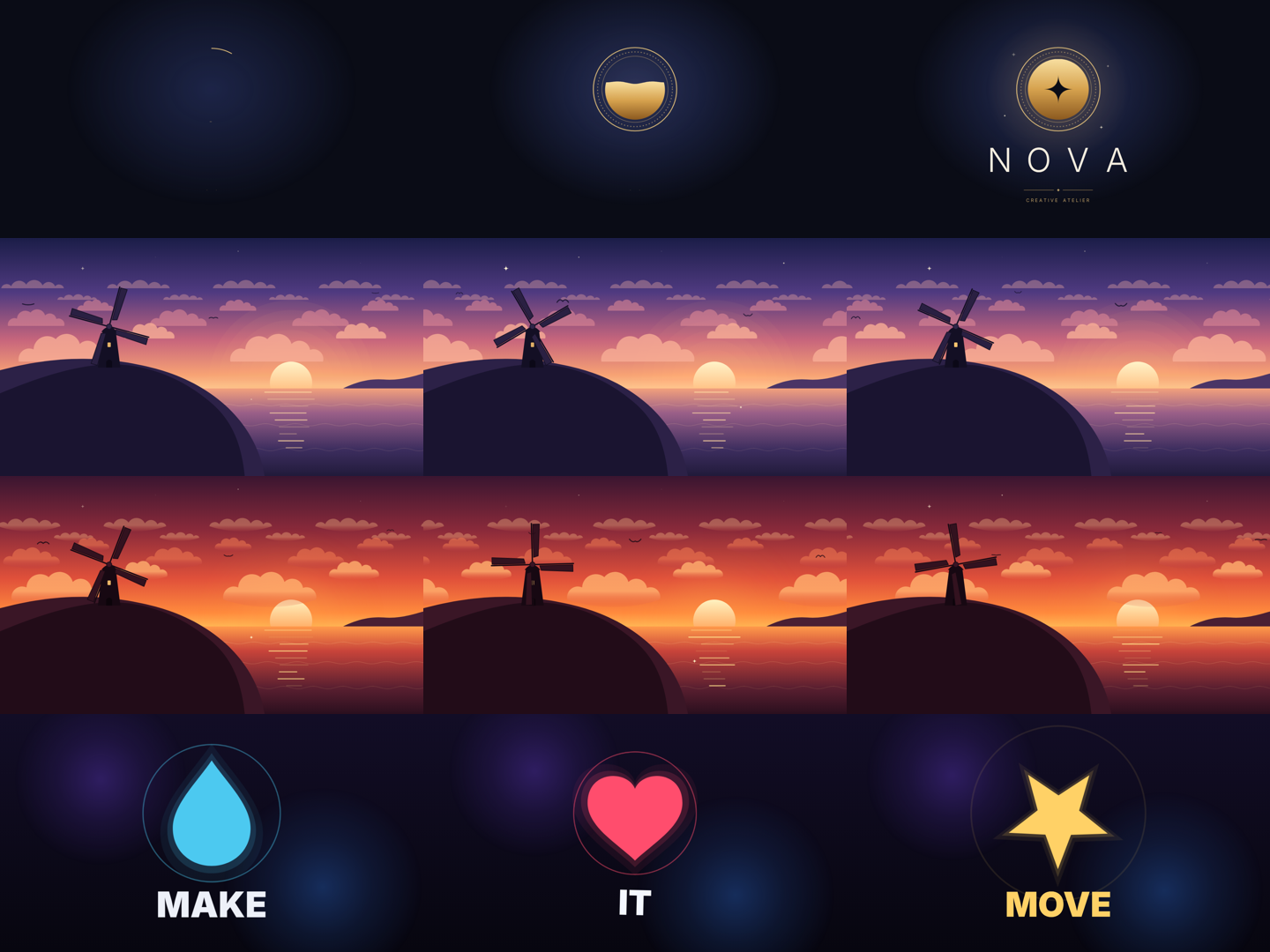
Then the same edit request went to both: "make the second one sunset-toned and 1.5× faster." A rewrote the palette and the duration; the frames at 0 ms and 5,333 ms are pixel-identical, so the loop is still seamless. B retimed every keyframe to ⅔ and saved the result as a new project. The original is untouched byte for byte.
I checked all seven exports separately: a fresh Chromium, loaded over file://, frames captured at fixed times. Result: 0 console errors and 0 network requests. They really are standalone.
My read:
- Output quality: A is better. The particle piece is portfolio-grade.
- Tool for a human: B is better. It's the only one of the two a non-coder could use.
- The general lesson: the agent's output is capped by what its own tool can express. B's editor has no blur, no glow, no masks, no stroke gradients. So B's agent faked them with stacked shapes, and the art came out flat. A's ceiling is the whole browser.
That last point is the one I'd bet on generalizing. In both arms, the decision that set the quality ceiling was made at tool-design time, not at any single generation step.
Where the reasoning was good, and where it wasn't
Good:
- A traced "the play button doesn't respond" to the platform instead of patching the app blindly: the shell's command dock overlays maximized windows and swallows clicks in the bottom strip.
- A's
captureFramediagnosis, above. It corrected its own first, wrong explanation ("background tab throttling") before landing on the main-thread one. - B kept anime.js out of its exports on purpose ("exports must have zero deps"), and did the sunset edit without destroying the original.
- A declined to install market apps, and said why.
Bad:
- A's first self-check said "done", but GSAP was being loaded from a CDN and the app's CSP blocks remote scripts, so the first run died with
gsap is not defined. Nothing in the agent-facing docs mentions this rule, which is on me. - Both arms verified with still frames and synthetic events. The dead click zone was only caught when the simulated user actually clicked.
- B treated an unanswered permission dialog (it times out after 60 s) as a denial, told the user to go change settings, and never updated that report after access was later granted.
- B stopped mid-task believing "the user rejected" its tool call. This one was a platform bug, not a reasoning failure:
- YAAR interrupts the running turn to deliver a message from another app agent.
- The SDK renders that interrupt to the model as "The user doesn't want to proceed with this tool use… STOP".
- The model did exactly what it was told.
Cost
Of the total, 97% is cache reads. B cost about 1.9× more, for three reasons: a bigger tool, more fix rounds, and a 44-layer project state passing through the agent channel on every call. Part of it is also confounded with how hard B's simulated user tested (see caveats). Each simulated user cost about 260 to 280k tokens on top.
Side effect: it's a good bug-finding harness
Real platform bugs found in one afternoon, each verified against a live instance or the logs (yaar#178):
- The command-palette stack swallows clicks over the bottom ~75 px of maximized windows. One of the culprits is an invisible 600×28 strip.
- A system interrupt is rendered to the model as a user rejection (above).
- Agent-created shortcuts duplicate the auto-created app shortcuts (
addShortcutdoesn't dedupe by target).
The improvement proposals that came out of the comparison are in yaar#179. This is the same dynamic as the bug-reporting post: agents doing real work in the OS are the best QA the OS will ever have. A two-arm comparison just concentrates it.
Caveats
I'd rather write these down than have someone else do it for me.
- n=1 per arm. No variance estimate. A 100-minute stochastic run could go very differently next time.
- The arms differ in the prompt, not just the environment. "A had better art" is partly "code tasks have a higher ceiling". This is not an environment comparison and not a model comparison.
- The simulated user is a confounder. B's user did more real mouse testing, found more bugs and triggered more fix rounds. τ-bench-style user simulation has the same problem.
- Circular judging. Builder, user and judge are all the same model family. "Portfolio-grade" is my opinion, nothing more.
- Not hermetic. Live market network, 60 s permission timeouts, and the two instances' dev builds restarting each other (A lost a turn to this).
- Model and platform are entangled. Some "agent failures" were YAAR bugs. That's great for product dogfooding and noise for model evaluation.
How far from a real benchmark?
For comparison: Terminal-Bench is Docker plus test scripts. SWE-bench is hidden unit tests. OSWorld is VM snapshots plus execution checks. τ-bench is a simulated user plus a database end state plus pass^k.
The good news: most of what I checked by hand is already automatable, and several checks came out of this run as by-products:
Still needed:
- a mocked market and pre-approved permissions (or make permission handling its own task, explicitly)
- a scripted user simulator with a fixed turn budget
- k ≥ 3 runs per arm with pass^k
- the same task on the Codex provider. YAAR already supports it, so the model-comparison axis is free.
What no existing benchmark measures, and this does:
- Tool-making as part of the task. The agent designs its tool, gives the tool an agent protocol, uses it, and repairs it. In both arms, the decision that set the quality was the tool's design (A's single clock), not any single generation.
- A computer-use target whose UI is different every run. For the outer agent, YAAR's UI is generated fresh by another AI each time, so there is nothing to memorize. That's an interesting property for GUI-agent evals, where memorized layouts are a known leak.
So: primitive, yes. But the loop that matters, an agent building the tool it is graded through and repairing that tool's instruments when they break, happened on its own, in an afternoon, and most of the grading can be scripted. The next step is boring and necessary: k=3 per arm, a second provider, and a user simulator that behaves the same way every time. Code, as always, at github.com/sorryhyun/yaar.